Fall has arrived and here at Maryland Sled Dog Adventures LLC we are busy doing one of three things: (1) training the sled dogs; (2) planting the Fall vegetables and flowers; (3) talking dogs with other mushers.
Yesterday, marked the first real training run of the season for the Maryland Sled Dog Adventures sled dogs. We arrived at the trail head early at about 6:30 am. Temps were at 50 degrees according to the new dog truck thermometer. We quickly set about hooking up veteran leader, Zoe, and upcoming leader, Acadia, both in lead with Sobo and Okemo in wheel and set off for a brisk five mile run which took us from Maryland into Pennsylvania and back. The dogs ran awesome. Along the way, we encountered several challenges, two horse farms that needed passing (Zoe was her usual awesome self, Acadia was decent, Sobo was surprisingly good, and Okemo needs work), several bicyclists that also needed head on and over taking passes, and several joggers. The biggest challenge was the 250 plus people who arrived at the trail head about 5 minutes after we did to run a race. While the spandex clad runners complained about the cold, we hooked up the dogs and headed down the trail in the opposite (north) direction towards Pennsylvania. We cruised up the trail for about 2.5 miles with speeds ranging from 18 MPH to 8-10 MPH. Our moving average was approximately 9 MPH. At our turn around point, just south of the Pennsylvania town of New Freedom, we took a brief break and practiced our line out training. As we headed back to the trail head, we encountered the 250 plus joggers and runners walking up the trail to the start of their race. Miraculously, the dogs stayed gee'd over and didn't freak out. Not bad for the first real training run (besides our scooter run last weekend).
Yesterday also included planting our Fall garden crops. In went the lettuces and garlic which will be over wintered. Our spring planting of shallots was so awesome, I really wanted to do another crop of Fall shallots, however, finding shallots in Maryland for Fall planting is apparently impossible.
Our spring plantings of tomatoes and peppers are still going really strong generating about 5-6 tomatoes per day and an unhealthy number of cayenne, jalapeno, Mexi-bell, green bell, and Giant Marconi peppers. We're also still harvesting lots and lots of fresh herbs.
After planting and training, Eric and I headed up to meet up with a retired musher friend of ours for some dinner and dirt track racing at Williams Grove speedway in Pennsylvania. Of course, sled dogs and fall training were a big topic of discussion.
Today, we're hoping to get planted the spring flowers, allium, tulips, daffodils, and irises, that we picked up yesterday at the store.
Monday, September 6, 2010
Monday, August 30, 2010
First Run of the Season
Saturday morning was cool enough for a very light run with the sled dogs and some (heavier) musher socialization. Since here at Maryland Sled Dog Adventures LLC we are frequently running dog sledding programs on the weekends later in the season, we took this opportunity to get together with several local mushers we have not seen for quite awhile. This was also a good opportunity to try out the new dog truck.
Run details: About one mile, Patsy's trail, haw (left) at the road and back around to the North Appleton lot; 3 dogs on the Pawtrekker dog scooter. Acadia and Sobo in lead with Okemo in wheel.
Run location: Fair Hill, Maryland
Notes: Warm, sunny and dry conditions (temps were 55 degrees when we arrived); large group of high school students running sprints right out of the parking lot (dogs did excellent at on-bying and were not phased by the announcer with the PA system). The dogs did not want to on by Eric and Zoe who were along the trail taking photos. Three dog scooter team = scary dog scooter run. Thankfully, I did not wipe out but there were some very close calls and the brakes were pretty much locked up for most of the run.
We didn't get many photos but here are a few that Eric did manage to capture. Note: Eric was standing well off the trail since he had Zoe out for a walk which is why the teams appear very small in most of these photos.
Friday, August 27, 2010
New Dog Truck!
Fall is just around the corner here in the Mid Atlantic and with the arrival of fall comes the beginning of a new dog sledding season for the Maryland Sled Dog Adventures sled dogs. This year, we have a great line up of dog sledding programs booked in including lots and lots of Girl Scout Programs, many Yappy Hour dog sled rides, several Run What You Brung training programs, and quite a few dog sledding Birthday Parties. New for 2011, we're offering a four day, three night women's only dog sledding adventure based out of our cabin in western Maine. Our Maine Winter Cabin Adventure is limited to just six participants and has several individuals already registered so don't delay if you are interested in registering for this very special dog-based adventure. For information on all of our programs, visit the Tours page of our website or our special Maine Winter Cabin Adventure website.
With Fall just around the corner, Eric and I are beginning to wrap up the summer's "dog projects." The biggest of these projects concerns the dogs' (and our) new transportation, our new dog truck.
The new dog truck is a 2010 5.7L 4WD Toyota Tundra, extra cab, long box (bed) pick up truck. The types of vehicles that mushers use to carry their dogs varies quite a bit based on the total number of dogs they need to carry and in what types of conditions. Some mushers use vans, some use SUVs, some use box trucks, and some use trailers. By far, however, the vast majority of mushers use pick up trucks, either with or without the bed, with dog boxes built on the back. This is the system we are now using.
Until recently, we were using a Ford Expedition (SUV) to carry our five sled dogs. To transport the dogs, Eric built a system of crates in the back of the Expedition. We knew at the time we purchased it, however, that the Expedition was only a short (less than five year) solution since five dogs, plus gear, plus two people was really the limit the Expedition could carry.
As part of the conversion to the a new dog truck, summer project number one was to purchase the truck and then begin construction on the boxes. In searching for the truck, we test drove, researched and evaluated four trucks and many varieties (engine size) of those trucks including Ford 150, Dodge Ram 1500, Chevy Silverado, and the Toyota Tundra. The Toyota Tundra 5.7L won out with the Chevy Silverado a close second. While we did consider a 6.5 foot bed (the standard sized bed for a double/extended cab pick up) we ultimately decided that a long box (8 foot bed) was required and better served the truck's function as a dog truck. The Tundra was purchased from Russel Toyota in Baltimore, Maryland. The purchase went fairly smoothly.
At the end of June we purchased the Tundra. During the month of July, we built an 8-dog box with boxes large enough to double dogs should we ever need to carry up to 16 dogs! The biggest issue with the construction process was that we were under a very tight time line because we really wanted to make it to Eric's family reunion in Maine. We did miss the reunion this year but did make it to Maine, leaving only two days later than anticipated. Eric estimates that the total time spent building the boxes was approximately 250-300 hours (that's a lot of time on top of a full time job all done between July 1st and July 31st). We spent an additional 50-60 hours researching different dog box configurations, drawing up plans, and sourcing and purchasing materials. Most of the materials were not "off the shelf" components from Home Depot/Lowes. Most were specialty items that had to be ordered, purchased, and delivered. We did make several trips to Grainger and Fastenal for various components. The Southco T-Handle marine polished stainless latches were sourced through ebay and shipped from Florida. The metals and plastics came from several different places in Maryland and Delaware. Let's just say, we visited some very industrial Baltimore and Wilmington locations. We also purchased various specialized grinding wheels, drill bits, rivets, riveters, tips for the plasma cutter, and welding supplies.
Double boxing already!
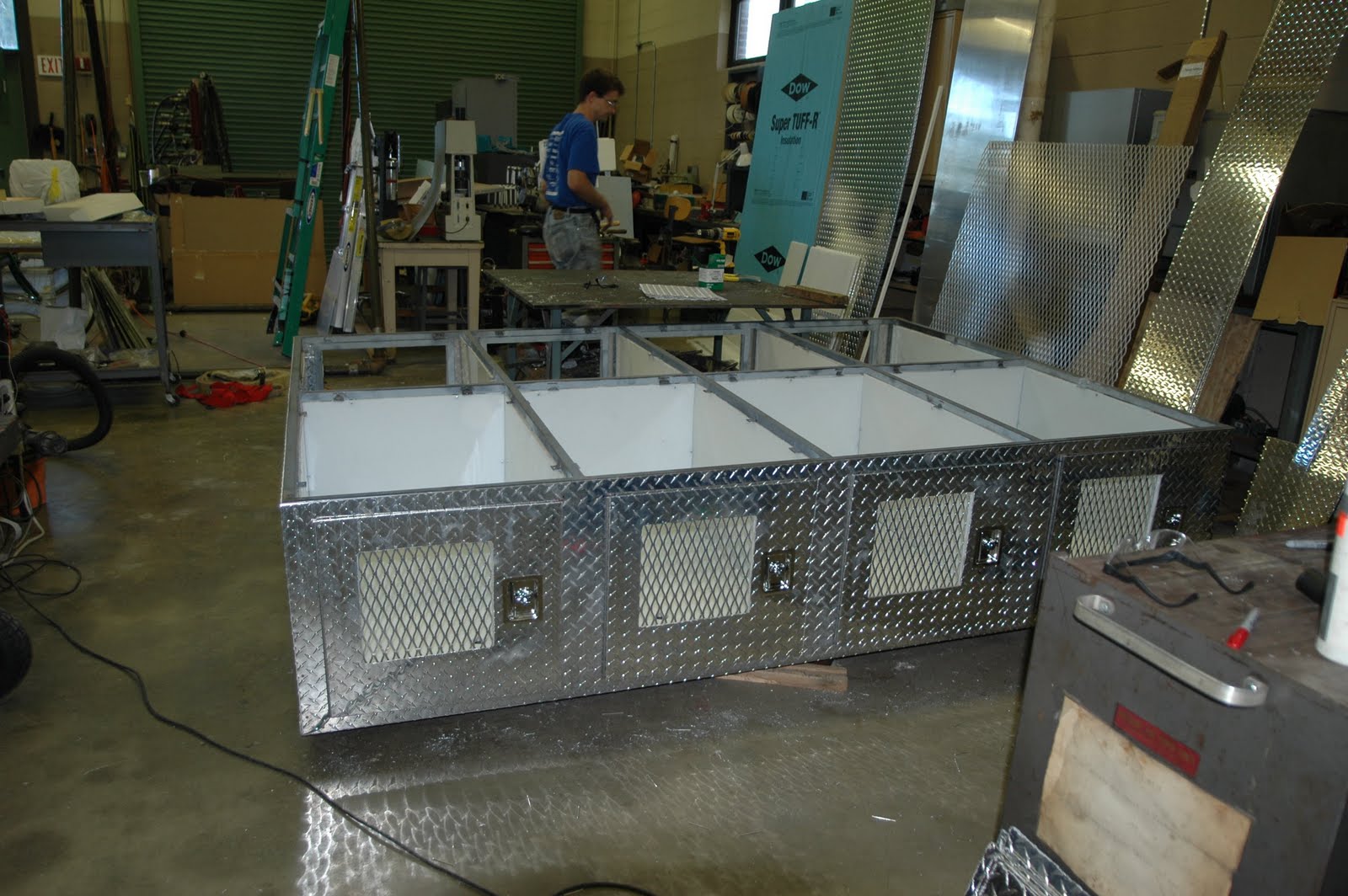
The boxes Eric designed and built are framed in steel, insulated with one inch foam insulation, lined in HDPE (high density poly ethylene) plastic, outfitted with stainless steel hardware including Southco (marine grade) polished stainless T-handle latches, and finished in polished, aluminum diamond plate. The boxes rest on a frame made of welded steel that is bolted to the frame of the truck.
Day 1: Welding the box frame (this is when welding was still fun)
Grinding
Clamping the frame so it can be welded.

Test fitting the box frame to the back of the truck and the bed frame: A two ton hoist was used to put the frame (and the finished boxes) on the truck.
Insulating the bottom of the boxes and cutting and fitting the HDPE that lines the boxes
Dog box lined on four sides with HDPE. The hole in the bottom allows access to the mounting brackets and bolts. The holes were latter plugged with rubber stoppers.

We will finish off the project with a pull out drawer for the bed of the truck that will ride below the dog boxes. This "drawer" will be used to carry gear, the dogs and ours. Ultimately, should we ever need or want to remove the bed of the truck, we could build another course of dog boxes that would allow us to to have a 16 hole (box) truck. At present, we're in the process of adding outriggers for picketing the dogs and a sled rack for carrying our dog sleds. We'll also be designing and building a ramp for loading some of our heavier dogs. We'll continue to use the hitch mounted carrier that Eric designed and built to carry our Fritz Dyck rigs (dog sleds on wheels). (For information on where we purchase our rigs, please visit the resources page of our website). We were pleased to learn last night that the hitch carrier will fit into the new dog truck's hitch without any modifications.
The new dog truck has now been through its "sea trial" phase and just returned from our Up North Summer Adventures. Along the way, we made a couple of changes, adding additional hinges to the door guards to add additional support and running a protective strip of rubber tubing along the back edge of the door guards. We may also add a locking latch to the door guard on each side so that the dogs don't break curfew! We were pleasantly surprised by how comfortable the dogs were riding in their boxes and how cool the dogs were during the long ride to and from Maine. All in all, we are just thrilled with our new dog truck. To see additional photos of the new dog truck, check out our Facebook page.
At the cabin up in Maine
Looking down the side of the truck at the cabin up in Maine. The full HDPE plastic slides are used to keep dust, dirt, and rain from entering the boxes when the truck is parked. A second set of vented slides is available for use to "warm" up the boxes when traveling on particularly cold days.
With Fall just around the corner, Eric and I are beginning to wrap up the summer's "dog projects." The biggest of these projects concerns the dogs' (and our) new transportation, our new dog truck.
The new dog truck is a 2010 5.7L 4WD Toyota Tundra, extra cab, long box (bed) pick up truck. The types of vehicles that mushers use to carry their dogs varies quite a bit based on the total number of dogs they need to carry and in what types of conditions. Some mushers use vans, some use SUVs, some use box trucks, and some use trailers. By far, however, the vast majority of mushers use pick up trucks, either with or without the bed, with dog boxes built on the back. This is the system we are now using.
Until recently, we were using a Ford Expedition (SUV) to carry our five sled dogs. To transport the dogs, Eric built a system of crates in the back of the Expedition. We knew at the time we purchased it, however, that the Expedition was only a short (less than five year) solution since five dogs, plus gear, plus two people was really the limit the Expedition could carry.
As part of the conversion to the a new dog truck, summer project number one was to purchase the truck and then begin construction on the boxes. In searching for the truck, we test drove, researched and evaluated four trucks and many varieties (engine size) of those trucks including Ford 150, Dodge Ram 1500, Chevy Silverado, and the Toyota Tundra. The Toyota Tundra 5.7L won out with the Chevy Silverado a close second. While we did consider a 6.5 foot bed (the standard sized bed for a double/extended cab pick up) we ultimately decided that a long box (8 foot bed) was required and better served the truck's function as a dog truck. The Tundra was purchased from Russel Toyota in Baltimore, Maryland. The purchase went fairly smoothly.
At the end of June we purchased the Tundra. During the month of July, we built an 8-dog box with boxes large enough to double dogs should we ever need to carry up to 16 dogs! The biggest issue with the construction process was that we were under a very tight time line because we really wanted to make it to Eric's family reunion in Maine. We did miss the reunion this year but did make it to Maine, leaving only two days later than anticipated. Eric estimates that the total time spent building the boxes was approximately 250-300 hours (that's a lot of time on top of a full time job all done between July 1st and July 31st). We spent an additional 50-60 hours researching different dog box configurations, drawing up plans, and sourcing and purchasing materials. Most of the materials were not "off the shelf" components from Home Depot/Lowes. Most were specialty items that had to be ordered, purchased, and delivered. We did make several trips to Grainger and Fastenal for various components. The Southco T-Handle marine polished stainless latches were sourced through ebay and shipped from Florida. The metals and plastics came from several different places in Maryland and Delaware. Let's just say, we visited some very industrial Baltimore and Wilmington locations. We also purchased various specialized grinding wheels, drill bits, rivets, riveters, tips for the plasma cutter, and welding supplies.
Double boxing already!The boxes Eric designed and built are framed in steel, insulated with one inch foam insulation, lined in HDPE (high density poly ethylene) plastic, outfitted with stainless steel hardware including Southco (marine grade) polished stainless T-handle latches, and finished in polished, aluminum diamond plate. The boxes rest on a frame made of welded steel that is bolted to the frame of the truck.
Another side of the box frame with door frames
All framed up with cross bracing
The bed frame: the boxes rest on this frame which is bolted to the frame of the truck via the bed bolts
Mounting bracket on the box frame: The bracket connects the boxes to the bed frame
All framed up with cross bracing
Mounting bracket on the box frame: The bracket connects the boxes to the bed frame
Test fitting the box frame to the back of the truck and the bed frame: A two ton hoist was used to put the frame (and the finished boxes) on the truck.
Insulating the bottom of the boxes and cutting and fitting the HDPE that lines the boxes
Dog box lined on four sides with HDPE. The hole in the bottom allows access to the mounting brackets and bolts. The holes were latter plugged with rubber stoppers.
Cutting door holes in the sides of the diamond plate with the plasma cutter
Riveting the sides on the dog box. Over the course of the project we used two full boxes of rivets, several different rivet sizes, and three separate riveters including an air driven riveter and the mechanical one you see Eric using in this photo.
Once holes were cut in the diamond plate for the grate and the latch, the edges were smoothed using a grinder and file.
Four doors hung: As you can see, the hinges were originally hung on the back side of the door. Although this gave a cleaner look, it also allowed the doors to gap at the side closest to the hinge. Stay tuned for how we fixed that little problem.
Another photo of the side of the box
Close up of the back side of a door and the expanded aluminum grate
Close up of the Southco T-Handle latches in polished stainless steel
Rubber Southco latch that holds up the door guards. We later added a second rubber Southco latch to each side for extra security.
Cable that holds the door guards in the down position
Re-mounting the doors with the aluminum ribbon hinges on the outside to minimize the gap. While it's not quite as clean looking, we really did not want the box doors leaking (and they don't). This is how we fixed the problem of doors that gapped on the side closest to the hinges.
Painted bed frame: This is the area where we will install the pull out drawer. It's a huge storage space.
Acadia's new dog box
Interior of one of the new dog boxes--the rubber stopper covers the hole used to access the bolts that mount the boxes to the bed frame.

Riveting the sides on the dog box. Over the course of the project we used two full boxes of rivets, several different rivet sizes, and three separate riveters including an air driven riveter and the mechanical one you see Eric using in this photo.
Close up of the back side of a door and the expanded aluminum grate
Close up of the Southco T-Handle latches in polished stainless steel
Rubber Southco latch that holds up the door guards. We later added a second rubber Southco latch to each side for extra security.
Cable that holds the door guards in the down position
Re-mounting the doors with the aluminum ribbon hinges on the outside to minimize the gap. While it's not quite as clean looking, we really did not want the box doors leaking (and they don't). This is how we fixed the problem of doors that gapped on the side closest to the hinges. Looking down the side of the truck with the door guards open: We added a second Southco rubber latch for the door guards to better secure the door guards when traveling.
We will finish off the project with a pull out drawer for the bed of the truck that will ride below the dog boxes. This "drawer" will be used to carry gear, the dogs and ours. Ultimately, should we ever need or want to remove the bed of the truck, we could build another course of dog boxes that would allow us to to have a 16 hole (box) truck. At present, we're in the process of adding outriggers for picketing the dogs and a sled rack for carrying our dog sleds. We'll also be designing and building a ramp for loading some of our heavier dogs. We'll continue to use the hitch mounted carrier that Eric designed and built to carry our Fritz Dyck rigs (dog sleds on wheels). (For information on where we purchase our rigs, please visit the resources page of our website). We were pleased to learn last night that the hitch carrier will fit into the new dog truck's hitch without any modifications.
The new dog truck has now been through its "sea trial" phase and just returned from our Up North Summer Adventures. Along the way, we made a couple of changes, adding additional hinges to the door guards to add additional support and running a protective strip of rubber tubing along the back edge of the door guards. We may also add a locking latch to the door guard on each side so that the dogs don't break curfew! We were pleasantly surprised by how comfortable the dogs were riding in their boxes and how cool the dogs were during the long ride to and from Maine. All in all, we are just thrilled with our new dog truck. To see additional photos of the new dog truck, check out our Facebook page.
Labels:
dog,
dog sled rides,
dog sledding,
dog trucks,
dogs,
Maine Winter Cabin Adventure
The Garden is Flourishing
The dog yard gardens here at Maryland Sled Dog Adventures don't seem to have suffered much in our absence.
As you can see in the photos they are productive...almost too productive. We're now keeping busy canning and putting up lots of tomato sauce. We're having a great harvest of Early Girl tomatoes but our Brandywine tomatoes are a bit disappointing. Many have rotted on the vine and also the productivity has been low. Next year, we may look at a different heirloom variety despite the rave reviews that Brandywines seem to get in this area. We're hoping they will kick it up a notch now that it's late August and into early September.
The peppers are making up for any Brandywine tomato disappointment and are literally the largest and most prolific peppers that Eric and I have ever grown. We planted one bell pepper, one cayenne pepper, one jalapeno pepper, one mexi bell pepper, and one Giant Marconi. All are producing in abundance and the Giant Marconi (a sweet pepper) is HUGE. We've also harvested several Ichiban eggplants from our one eggplant plant and tons of herbs. Earlier in the season we had a great shallot harvest. Our gardens may be small but they are productive.
Thursday, August 26, 2010
Up North Summer Adventures
Eric and I along with the whole crew of Maryland Sled Dog Adventures' sled dogs, just returned from a little over three weeks of up north adventures at our cabin in Maine.
Chloe: These dogs are so undignified!
While in Maine we had a blast white water river rafting at the Forks, picking blackberries, hiking, making blackberry jam, visiting the Wilton Blueberry Festival, near daily swims at Clearwater Pond, camp fires, hosting several of our musher friends at a backyard BBQ, watching the stars, enjoying the silence, and, in general, just relaxing "up to camp." We saw several moose including a mama and two babies, a porcupine, several deer, tons of dragonflies, and many butterflies. We also heard the yips of coyotes in the distance. We also visited several swimming holes including Smalls Falls and Coos Canyon. Of course, we also did quite a bit of work while up at the cabin including work on the trails surrounding the cabin (we built a pallet bridge over a low spot on the trail that ties us into the main trail), split and stacked wood, and cut down several trees.
Team mascot, T-Bone, romps on the trail
Subscribe to:
Posts (Atom)